






















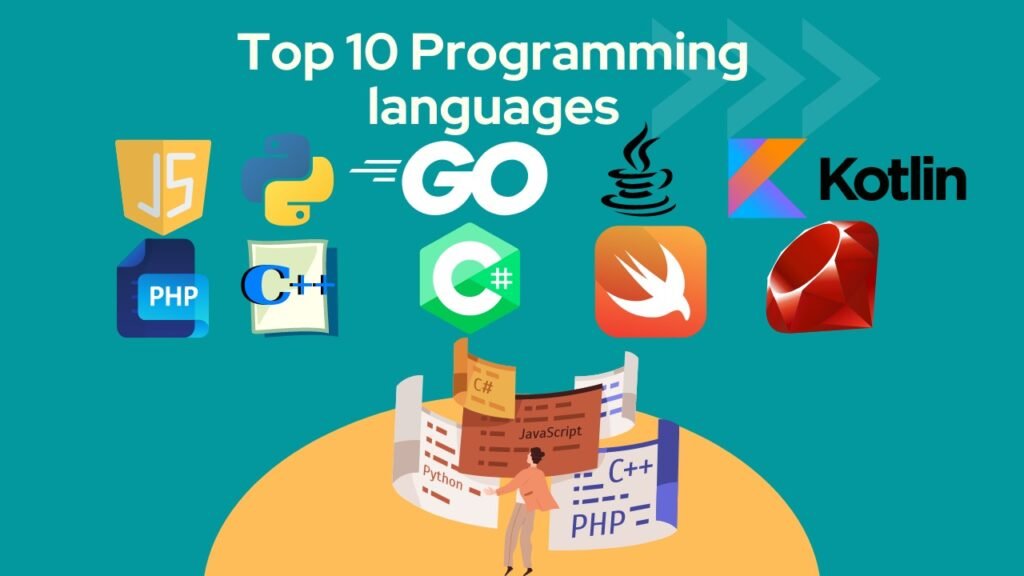
Below is a list of the most popular and best programming languages that will be in demand in world.
1.Javascript.
2.Python.
3.Go.
4.Java.
5.Kotlin.
6.PHP.
7.C#
8.Swift.
9.Ruby.
10.c++
JavaScript
JavaScript runs in the user’s web browser as a client-side language, allowing it to modify web pages in real-time without communicating with the server. Developers use JavaScript to add dynamic effects, animations, and interactive user interfaces to web pages. They also create browser-based games, mobile applications, and server-side applications using Node.js.
Some of the key features of JavaScript include its support for object-oriented programming, functional programming, and asynchronous programming. It also has a large number of libraries and frameworks, such as jQuery, React, and Angular, that make it easier to develop complex applications.
Requirements of JavaScript
JavaScript requires a text editor to write code, a web browser to run and display the code, and knowledge of programming concepts such as variables, functions, and control structures. It also requires an understanding of the Document Object Model (DOM) and how it is used to manipulate web page elements.
Popularity of JavaScript
Versatility: JavaScript is a versatile language that can be used for both front-end and back-end web development, as well as desktop and mobile application development.Easy to learn: JavaScript is relatively easy to learn, especially for those with some programming experience. There are many resources available online to help beginners get started with JavaScript.
Large community: JavaScript has a large and active community of developers who contribute to the language’s growth and development. This community has created many libraries, frameworks, and tools that make it easier to build web applications with JavaScript.
Compatibility with HTML and CSS: JavaScript works seamlessly with HTML and CSS, which are the building blocks of the web. This allows developers to create dynamic and interactive web pages and applications.
Cross-platform compatibility: JavaScript runs on almost every platform and browser, making it an ideal choice for building cross-platform applications.
Rich library ecosystem: The JavaScript community has created many libraries and frameworks that make it easier to build complex web applications. These libraries and frameworks provide developers with pre-built functionality, which can save time and effort in development.
Python
Developers first released Python in 1991 as a high-level, interpreted programming language. Its simple syntax, readability, and versatility make it a popular choice for both beginners and experienced programmers. Since Python is open-source, anyone can use and modify it freely.
Developers use Python for a wide range of applications, including web development, scientific computing, data analysis, artificial intelligence, and machine learning. A large and active community continuously contributes to its growth by creating libraries, frameworks, and tools that enhance its usability.
Python’s simplicity and ease of use make it an excellent language for beginners. Its clear and concise syntax improves readability and understanding. Additionally, an extensive collection of online resources, including documentation, tutorials, and libraries, supports Python learners and professionals.
Python’s versatility allows developers to build applications in various fields, such as web and game development, scientific computing, AI, and machine learning. This flexibility has made Python one of the most widely used programming languages worldwide.
Finally, Python’s strong developer community remains one of its greatest strengths. Community members actively share knowledge, provide support, and develop numerous libraries, frameworks, and tools that simplify application development with Python.
Requirements of Python
Python interpreter: You will need to install the Python interpreter on your computer. The latest version of Python can be downloaded from the official Python website. Python is available for Windows, Mac OS X, and Linux operating systems.
Integrated Development Environment (IDE): While it is possible to write Python code using a simple text editor, it is recommended to use a full-featured integrated development environment (IDE) for development. Some popular Python IDEs include PyCharm, Visual Studio Code, Sublime Text, and Atom.
Libraries and modules: Python has a vast number of libraries and modules that can be used to extend its functionality. Some of the most popular libraries include NumPy, Pandas, and TensorFlow. You can install these libraries using the pip package manager, which comes with the Python interpreter.
Basic knowledge of programming: Although Python is known for its simplicity and ease of use, it still requires a basic understanding of programming concepts. To use Python effectively, you need to learn fundamentals such as variables, loops, functions, and conditionals.
Popularity of Python
Simplicity: Python has a simple and readable syntax that is easy to learn and understand, especially for beginners. Its simplicity has made it a popular language for teaching programming in schools and universities.
Versatility: Python can be used for a wide range of applications, from web development to scientific computing, data analysis, artificial intelligence, and machine learning. Its versatility has made it a popular choice for developers and businesses.
Large community: Python has a large and active community of developers who contribute to its growth and development. This community has created many libraries, frameworks, and tools that make it easier to use and has also provided a wealth of resources for developers, including documentation, tutorials, and support forums.
Availability of libraries and frameworks: Python has a vast number of libraries and frameworks that make it easier to develop applications. These libraries and frameworks provide pre-built functionality, which can save developers a lot of time and effort in development.
Scalability: Python can be used for both small and large-scale projects, making it a popular choice for startups and large enterprises alike. Its scalability has made it an ideal language for building web applications and services.
Data science and machine learning: Python has become a dominant language in the data science and machine learning communities. It has many libraries, such as NumPy, Pandas, and TensorFlow, that make it an ideal language for data analysis and machine learning.
Open-source: Python is an open-source language, which means that it is free to use and can be modified by anyone. This has led to a large and active community of developers who contribute to its growth and development.
Go
Go is a simple, efficient, and reliable programming language, well-suited for building large-scale distributed systems and web applications.
As a statically typed language, Go features a C-like syntax while incorporating additional capabilities such as garbage collection, memory safety, and built-in concurrency support. The designers prioritized simplicity, readability, and ease of use, making Go a popular choice for both experienced and novice developers.
Requirements of Go
Go compiler: The first requirement is to have a Go compiler installed on your computer. The compiler is used to compile and run Go programs. You can download the latest version of the Go compiler from the official website.
Text editor or IDE: You need a text editor or an Integrated Development Environment (IDE) to write and edit Go code. Popular text editors for Go include Sublime Text, Atom, and Visual Studio Code. IDEs such as GoLand and LiteIDE are also available.
Understanding of basic programming concepts: While Go is a simple language, you should have a basic understanding of programming concepts like variables, functions, loops, and conditionals.
Familiarity with command-line interface: Since developers often use Go through the command-line interface, you must be familiar with your operating system’s command-line tools.
Java
James Gosling and his team at Sun Microsystems developed Java in the mid-1990s as a popular general-purpose programming language. They designed it to be portable and platform-independent, allowing it to run on various hardware and software platforms.
As a high-level, object-oriented language, Java is known for its simplicity, robustness, and security. The compiler translates Java code into bytecode, which can run on any Java Virtual Machine (JVM), regardless of the underlying operating system.
Requirements of Java
Java Development Kit (JDK): The JDK is the software development kit for Java, which includes the Java Runtime Environment (JRE) and other tools needed to develop Java applications. You can download the latest version of the JDK from the Oracle website.
Integrated Development Environment (IDE): An IDE is a software application that provides a comprehensive development environment for programming in Java. Popular IDEs for Java include Eclipse, IntelliJ IDEA, and NetBeans.
Understanding of basic programming concepts: While Java is an easy language to learn, you should have a basic understanding of programming concepts such as variables, loops, and conditionals.
Familiarity with Object-Oriented Programming (OOP) concepts: Java is an object-oriented language, so it’s essential to have a basic understanding of OOP concepts such as classes, objects, and inheritance.
Kotlin
JetBrains, the makers of the popular IntelliJ IDEA IDE, developed Kotlin and first released it in 2011. They designed it as a modern, open-source programming language that runs on the Java Virtual Machine (JVM) and compiles to JavaScript or native code. Kotlin provides a more concise, expressive, and safer alternative to Java while maintaining full interoperability with existing Java code and libraries.
As a statically typed language, Kotlin supports functional programming constructs and includes features like extension functions, operator overloading, and null safety, enabling developers to write robust and maintainable code. Developers use Kotlin for various applications, including Android app development, server-side web development, and desktop applications.
Requirements of Kotlin
To develop applications in Kotlin, you need to set up a development environment like Android Studio or a text editor with a Kotlin compiler. Since Kotlin runs on the Java Virtual Machine (JVM) and is compatible with Java code, you must install the JVM on your system. Additionally, Kotlin compiles to native code and JavaScript, providing flexibility across different platforms.
For JVM-based development, Kotlin requires at least Java 8. However, if you’re targeting Android development, you must install the Android SDK and the Kotlin plugin in Android Studio. No other special requirements are needed to start building applications in Kotlin.
PHP
Web developers widely use PHP (Hypertext Preprocessor) as a server-side scripting language for web development. The server executes the code and sends the resulting output to the client’s web browser as HTML. Since PHP is open-source and easy to learn, many developers prefer it for building dynamic web pages, including social networking sites, e-commerce platforms, content management systems, and online forums. PHP also provides built-in support for database integration, making it an ideal choice for developing web applications that require database connectivity.
Requirements of PHP
To start developing with PHP, you need a development environment such as XAMPP, WAMP, or LAMP, which provides a web server, database server, and runtime. You also need a text editor or an integrated development environment (IDE) to write its code. It runs on various platforms such as Windows, Linux, macOS, and Unix. Additionally, it requires a web server, such as Apache or Nginx, to run the code. To work with databases, you need to have a database management system installed, such as MySQL, MariaDB, or PostgreSQL, and extensions for database integration. Finally, you should keep your installation up to date with security patches and bug fixes.
c#
Microsoft developed C# (pronounced “C sharp”) as a modern, object-oriented programming language. They designed it to be simple yet powerful, enabling developers to build a wide range of applications, including Windows desktop applications, web applications, and games. Since C# is strongly typed, developers must explicitly define the data type of each variable and object in the code. As a compiled language, C# translates code into machine code before execution, improving performance. As part of the .NET framework, C# allows developers to create applications that run on Windows, macOS, Linux, and other platforms.
Requirements of c#
To develop applications in C#, you need a development environment such as Microsoft Visual Studio, which provides a text editor, a debugger, and a compiler. C# is part of the .NET framework, so you need to have the .NET framework installed on your system. The framework includes a common language runtime (CLR), which is responsible for managing memory, executing code, and handling exceptions. C# is a compiled language, so you need to compile the source code into an executable file before it can be run. Additionally, you need to have a basic understanding of object-oriented programming concepts such as classes, objects, inheritance, and polymorphism to develop applications in C#.
swift
Apple Inc. developed Swift as a general-purpose, multi-paradigm, compiled programming language. They designed it to be safe, fast, and expressive, with a modern syntax that enhances readability and writability. Developers primarily use Swift to build applications for Apple’s platforms, including iOS, macOS, watchOS, and tvOS, but they can also use it for Linux and other platforms. Since Swift is an open-source language, its syntax draws inspiration from Objective-C, Rust, Haskell, and Python. It includes features such as optionals, closures, and generics, enabling developers to write safe and efficient code more easily.
Requirements of swift
To develop applications in Ruby, you need a development environment that includes the Ruby language runtime, a code editor, and a command-line interface. Ruby runs on various platforms, including Windows, Linux, and macOS. Users can install it from the official Ruby website or through package managers such as Homebrew or apt-get. Many developers use a code editor such as Visual Studio Code, Sublime Text, or Atom to write Ruby code. To develop web applications with Ruby, you can use a web framework such as Ruby on Rails or Sinatra, which provide tools for routing, handling requests and responses, and working with databases. Additionally, you can use the Ruby Gems package manager to install and manage libraries and dependencies.
c++
C++ is a powerful, high-performance, object-oriented programming language that extends the C language. Bjarne Stroustrup developed it in the early 1980s to improve C by adding features such as classes, templates, and operator overloading. Developers widely use C++ to build high-performance applications, including video games, operating systems, and scientific simulations. They also use it to create software tools, libraries, and frameworks. Since C++ is a compiled language, the compiler translates its source code into machine code before execution. As a statically typed language, C++ requires developers to define variable data types at compile-time.
Requirements of c++
To develop applications in C++, you need a development environment that includes a text editor, a compiler, and a debugger. There are many options for C++ development environments, including Microsoft Visual Studio, Xcode, Eclipse, and Code: Blocks. A compiler is required to compile C++ source code into executable code. Most modern compilers support C++11, C++14, and C++17 language standards, which provide new features and improvements over earlier versions of the language. C++ also requires an understanding of object-oriented programming concepts such as classes, objects, inheritance, and polymorphism. Additionally, you need to be familiar with the C++ Standard Library, which provides a set of functions and data structures for performing common tasks such as input/output, string manipulation, and memory management.

